Bedding & Sleep Resources
Organic Latex: A Guide to Dunlop Construction, Certifications, and Care
Organic latex can offer a resilient, long-lasting feel, but the phrase alone does not tell you how a mattress is built—or what has actually been certified. Learn how Dunlop latex is made, how to read material claims, what construction details matter, and how thoughtful care can help preserve a latex mattress over time.
Start with the layers, not the label
Shopping for a mattress can feel like parsing a new language. Terms such as “natural,” “organic,” “Dunlop,” and “certified” appear side by side, although they describe different things. One refers to a material’s origin or processing; another names a manufacturing method; a third may describe an independently assessed standard. To make a useful comparison, look past the headline claim and examine the mattress layer by layer.
A latex mattress may combine a resilient core with other materials, including wool batting, cotton fabric, or a removable cover. Each component contributes to the finished product, but a certification attached to one layer does not automatically apply to every part of the mattress. The clearest product information identifies the latex type, its thickness and firmness, the cover materials, any cushioning or fire-barrier layers, and the scope of relevant certifications.
That distinction matters whether you are comparing natural latex organic mattresses, considering a particular firmness, or trying to understand what “organic” means in a product description. A well-documented specification sheet is more valuable than a broad promise. It gives you details you can compare—and questions to ask when a detail is missing.
What is Dunlop latex?
Dunlop is a method of producing latex foam. In broad terms, liquid latex is prepared, poured into a mold, heated to set, and then washed and dried. The finished foam has a springy structure that compresses under weight and rebounds when pressure is released. The specific feel depends on the formulation, density, thickness, and design of the latex layer, not on the name of the process alone.
Latex foam is commonly made from rubber-tree sap, though formulations and supply chains vary. The word “Dunlop” describes how the foam is manufactured; it does not by itself establish whether the source material is organic, what additives were used, or whether the complete mattress meets a particular certification standard. Those are separate questions.
People often describe Dunlop latex as having a buoyant, supportive feel. It tends to respond quickly rather than slowly molding around the body. Some sleepers appreciate that combination of contouring and lift; others may prefer a different material or a different firmness. There is no universally right feel. Body shape, sleep position, sensitivity to pressure, and personal preference all affect whether a particular construction feels comfortable.
It is also useful to distinguish manufacturing method from firmness. Dunlop latex is sometimes assumed to be firm, but layers can be produced in different firmnesses. A mattress might use a firmer support layer below a softer comfort layer, or several layers arranged to achieve a particular feel. Ask for the firmness of each layer and how the manufacturer defines it; terms such as “soft” and “medium” are not always standardized across brands.
Dunlop and Talalay: a practical comparison
Dunlop and Talalay are two distinct latex manufacturing processes. Both can be used to make latex foam, and either may appear in a mattress alongside natural or certified materials. Their production steps differ, and that can affect the foam’s structure and feel. But a process name should not be treated as a shortcut for judging comfort, quality, or environmental performance.
Rather than deciding that one process is automatically superior, compare the actual mattress construction. Check the thickness and firmness of each layer, whether the foam is natural, blended, or synthetic, and what supporting documentation is available. Then consider the complete assembly: the cover, any quilted fibers, and the base on which the mattress will rest. These details help explain how a mattress may perform in daily use more reliably than a single label.
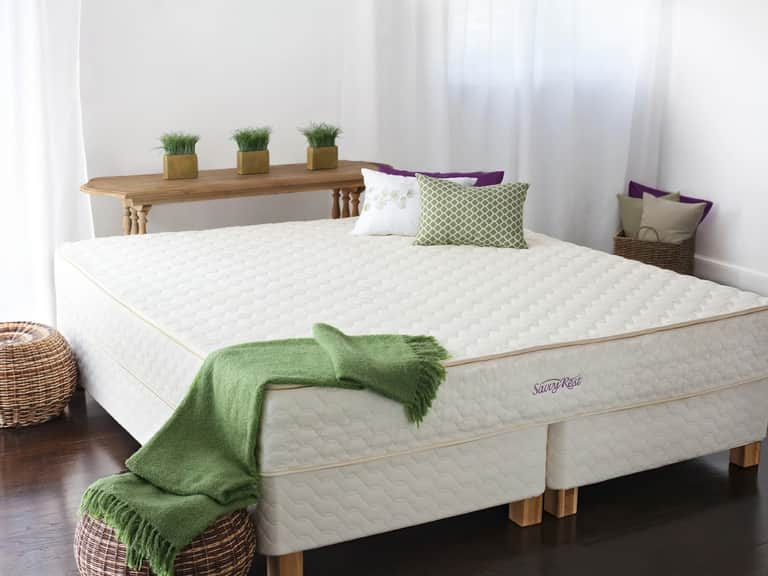
Layered designs can allow a mattress to be adjusted or configured in different ways. For example, the Savvy Rest Serenity Latex Mattress is described as a 10-inch mattress with three customizable layers of soft, medium, or firm Dunlop and/or Talalay latex. Its listed materials also include an organic cotton casing and organic wool quilting. Those are product-specific details; anyone considering the mattress should confirm the available configuration, current certification documentation, and care instructions directly with the seller or manufacturer.
What does “organic” mean in a latex mattress?
“Organic latex” is not a complete description of a finished mattress. It may refer to the latex material or to a verified part of its supply and processing chain, while the mattress itself may contain other components with different origins and standards. To understand a claim, find out exactly which materials are covered and which organization issued the certification.
Two standards readers may encounter are GOLS and GOTS. The Global Organic Latex Standard, commonly abbreviated GOLS, is associated with organic latex products and requirements for the supply chain and processing of latex. The Global Organic Textile Standard, or GOTS, applies to textiles and addresses criteria relevant to organic fibers and their processing. Because they concern different material categories, one does not simply replace the other.
For example, a mattress could describe its latex as certified under a latex-specific standard and its cotton cover as certified under a textile standard. That does not necessarily mean every component, adhesive, accessory, or manufacturing step is included in both certifications. The product documentation should say what is covered. If the claim is unclear, ask for the certificate or a current transaction document and check that the named product and material correspond to the claim.
Certification is useful evidence, but it is not a guarantee of a particular comfort level, durability, or health outcome. Nor does a certification for one component establish that a whole mattress is “chemical-free.” That phrase is broad and can be misleading. A more informative description names the material, the relevant standard, and the scope of the certification.
- Identify the certified material. Is the claim about latex, cotton, wool, or the complete product?
- Check the standard and certifier. Look for the full name of the standard and documentation that can be verified.
- Ask about uncovered components. Covers, thread, zippers, fire barriers, and other layers may have their own materials and specifications.
- Read the wording carefully. “Made with organic materials” is not identical to “the entire mattress is certified organic.”
These checks are practical, not adversarial. Reputable product information should make it possible to understand what a certification means without asking readers to infer more than the documentation supports.
How to compare construction details
A mattress comparison becomes clearer when the specifications are set out in the same order. Begin with the core: the latex type, the number of layers, their individual thicknesses, and their firmness. A “10-inch latex mattress,” for instance, may include several latex layers, but the total height alone does not tell you how much latex is present or how the mattress is arranged.
Next, examine the cover and any quilted materials. Organic cotton can be used as a fabric covering, while wool may appear as batting or as a component of the mattress casing. These layers influence the surface feel and the complete material profile. They are not interchangeable with the latex core, and their certifications should be considered separately when the documentation distinguishes them.
Then consider whether the layers can be rearranged, replaced, or customized. A configurable design may help sleepers fine-tune the feel, and split configurations can allow two people sharing a mattress to choose different firmnesses on each side when that option is available. Confirm how customization works, whether layers are removable, and what the exchange or return terms are. A feature is useful only if its limits are understood before purchase.
Finally, check practical fit. Confirm the mattress dimensions, total height, bed-frame compatibility, weight guidance, delivery arrangements, and warranty terms. If you use an adjustable base, verify that the specific mattress is approved for it. A mattress can have carefully selected materials and still be unsuitable for a frame or bedroom setup that does not meet its requirements.
A concise comparison checklist
- Latex type: Dunlop, Talalay, or a combination; natural, blended, or synthetic.
- Layer map: thickness, firmness, and position of each latex layer.
- Other materials: cover fabric, wool or other quilting, and any additional components.
- Certification scope: which materials are covered and by which standard.
- Care: spot cleaning, ventilation, rotation guidance, and restrictions on washing.
- Support: frame requirements, adjustment options, warranty conditions, and exchange policies.
Support and comfort are personal
Latex’s resilience can make it feel supportive and responsive, but comfort is not determined by material alone. A mattress that feels gently contouring to one person may feel too firm to another. Side sleepers may focus on cushioning around the shoulders and hips; back and stomach sleepers may pay closer attention to how the torso is supported. These are useful considerations, not rigid rules.
Firmness labels also need context. A mattress’s surface quilting, layer arrangement, and the sleeper’s body weight can change how the same nominal firmness feels. If you are trying a configurable mattress, ask how the manufacturer recommends choosing a starting arrangement and whether layer exchanges are available. Give a new setup time to feel familiar, while paying attention to persistent discomfort rather than relying on a label alone.
A pillow and mattress work together as a sleep surface. If changing a mattress alters how deeply the shoulder settles, the pillow’s loft may feel different as well. That does not mean a new pillow is automatically necessary; it is simply one more part of the overall setup to review if neck or shoulder comfort changes.
Care that helps preserve latex
Good care begins with the manufacturer’s instructions. Latex mattresses are not all constructed alike, and cleaning a cover as if it were a removable washable sheet can cause avoidable damage. Some covers are designed to be removed for access but are not machine washable. Others require spot cleaning only. Read the care label and product guidance before using water, detergent, steam, or cleaning equipment.
For a spot, use the method recommended by the maker and avoid soaking the latex. Excess moisture can be difficult to dry inside a layered mattress. If a cover is removable, confirm whether it may be washed; do not assume that a zipper means the cover is washable. Protecting the surface with suitable bedding can also reduce routine soil and help keep the mattress cleaner between care intervals.
Ventilation is another simple part of maintenance. A supportive bed frame that allows airflow beneath the mattress can help the sleep surface dry and air out. Follow the manufacturer’s guidance on slats, platform spacing, and center support, because an unsuitable frame may affect both performance and warranty coverage. In a humid room, keeping the surrounding area reasonably dry and allowing airflow around the bed are sensible household practices.
Rotate or flip a mattress only if the manufacturer recommends it. Some latex mattresses are designed with a specific top and bottom, so flipping them would place the layers in the wrong orientation. Others may benefit from periodic rotation. The product’s instructions—not a universal schedule—should decide the routine.
- Use a supportive frame that meets the maker’s requirements.
- Keep the mattress dry and follow label instructions for any spot cleaning.
- Use a mattress protector if appropriate, checking that its materials and fit suit the mattress.
- Do not machine wash, steam clean, or saturate a cover unless the care instructions explicitly allow it.
- Rotate or flip only as directed for that specific construction.
Understanding longevity and warranties
Latex is known for its resilience, but no mattress lasts indefinitely. Actual service life depends on construction, use, support, care, and the conditions of the warranty. A warranty is not a promise that a mattress will feel unchanged forever. It generally describes remedies for specified defects and sets out exclusions, measurement thresholds, and care requirements.
Before buying, read the warranty rather than relying on its headline length. Check whether it is limited, what kinds of sagging or material failure qualify, whether the original receipt is required, and whether an approved foundation must be used. For a customizable mattress, review whether the warranty applies to individual layers and how replacement or exchange terms work. Keep product records and care instructions in a place you can find later.
Durability claims deserve the same careful reading as organic claims. A material may be designed to remain resilient, but the performance of a complete mattress depends on more than one component. Ask about the construction and the evidence behind specific claims, and avoid treating a single material or certificate as a guarantee of a particular lifespan.
Questions worth asking before you decide
Clear answers can turn a complicated specification into a practical choice. If you are comparing organic latex, natural latex organic mattresses, or a layered Dunlop design, consider asking:
- Is the latex Dunlop, Talalay, or a combination, and what is its source material?
- How many layers are included, and what are the thickness and firmness of each?
- Which parts of the mattress are certified, under which standards, and can the documentation be reviewed?
- What materials are used in the cover and any quilting or fire barrier?
- Does the cover come off, and what cleaning methods are allowed?
- What kind of bed frame is required, and is the mattress compatible with an adjustable base?
- Can the layers be exchanged or rearranged, and what conditions apply?
- What does the warranty cover, and what care or support requirements must be met?
If an answer is vague, ask for the information in writing. A careful seller should be able to distinguish a product’s material facts from general benefits and clarify where a certificate applies. That transparency helps you compare options on their merits rather than on the strength of a slogan.
The bottom line
Dunlop latex describes a manufacturing process, not a complete verdict on a mattress. To understand what you are considering, look at the latex source and type, the arrangement and firmness of its layers, the cover and other materials, and the care requirements. Treat certifications as precise statements about particular materials and processes, then verify exactly what each one covers.
Organic latex bedding can bring together resilient support and materials such as organic wool and cotton. The best comparison is grounded in details: a transparent layer map, credible certification documentation, appropriate frame guidance, and clear care instructions. With those facts in view, the label becomes a starting point—not the whole story.